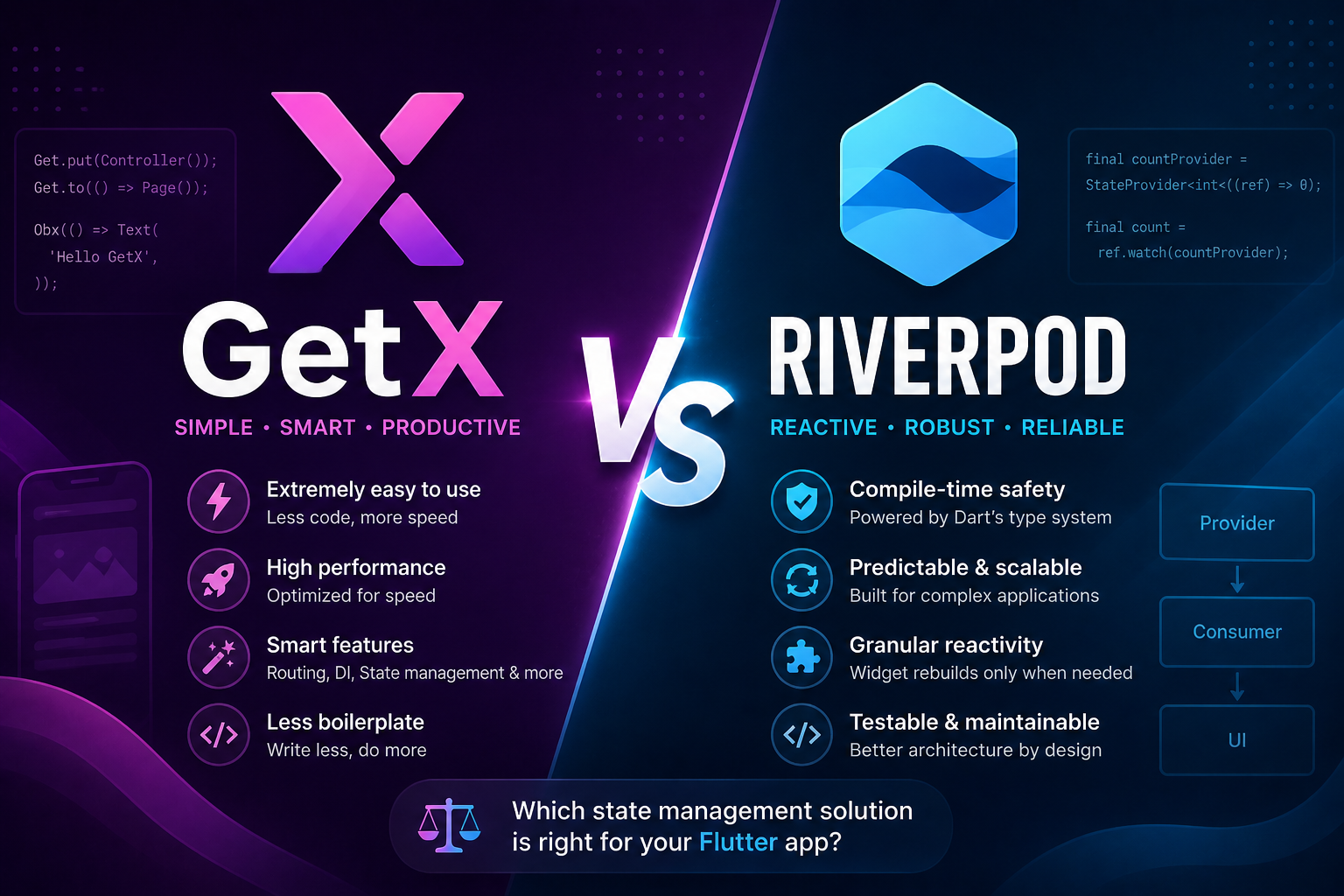
Flutter Riverpod vs. Bloc State Management: Which Is the Right Choice and Why
Both are excellent, both are opinionated in different directions, and the "right" answer depends more on your team and app shape than either library's technical merits.

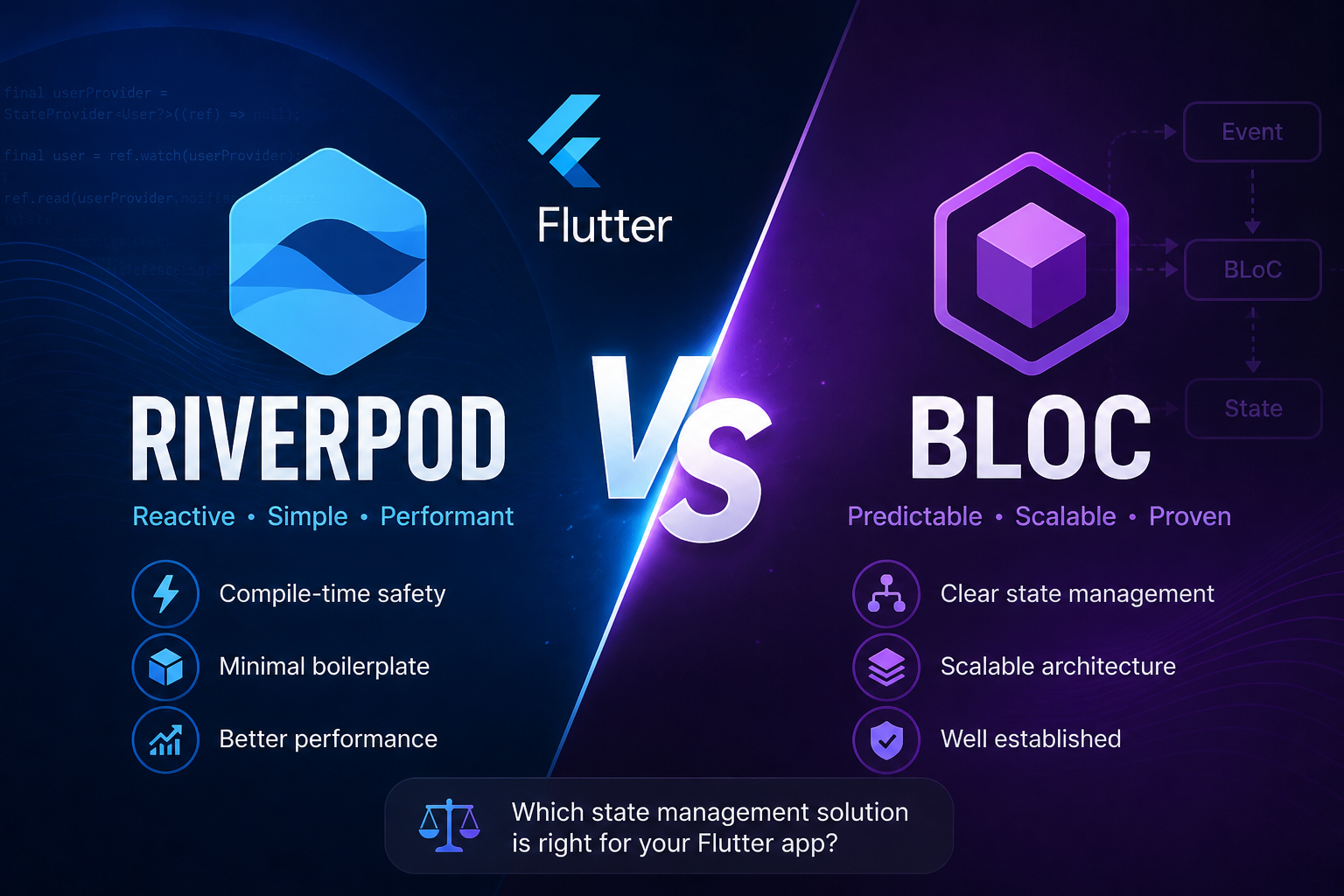
Every Flutter team eventually has this argument, usually right after the initial prototype works and someone realizes setState isn't going to scale. Riverpod and Bloc are the two most common answers, and both are genuinely good — which is exactly what makes the choice harder than it should be. Neither is obviously "more advanced" or "more correct." They optimize for different things.
What each one is actually trying to solve
Riverpod is fundamentally about dependency injection and reactive state, done in a way that's compile-safe and testable without needing BuildContext to access your providers. It grew out of the Provider package specifically to fix Provider's runtime-error-prone parts — accessing a provider that doesn't exist in the widget tree used to be something you only discovered by crashing the app; Riverpod catches that at compile time instead.
Bloc is built around a stricter idea: every state change happens through an explicit, named event, processed by a class whose entire job is turning events into new states. It's less "manage some reactive values" and more "model your app as a formal state machine." That formality is the whole point — Bloc wants every state transition to be traceable, replayable, and testable in isolation.
Where Riverpod genuinely wins
Less boilerplate for straightforward reactive state. If you're fetching data, holding it, and rebuilding some widgets when it changes, Riverpod lets you express that in a few lines — a provider, a consumer, done. Bloc wants you to define events, states, and a class connecting them even for something simple, which can feel like ceremony when the actual logic is "fetch this and show it."
Simpler mental model for smaller and mid-sized apps. A junior developer can be productive with Riverpod fast — the core idea ("read a provider, watch a provider, everything rebuilds automatically") is intuitive quickly. Bloc's event-driven model takes longer to click, especially the distinction between events (things that happen) and states (what the UI should show as a result).
More flexible for mixed concerns. Riverpod handles dependency injection, caching, and reactive state in one system, so you're not reaching for a second pattern when you need "just hold onto this value and share it across screens" versus "manage a complex multi-step flow."
Where Bloc genuinely wins
Enforced discipline at scale. On a large team, or a codebase that'll be maintained by people who didn't write it, Bloc's rigidity is a feature. Every state change has a name, a defined trigger, and a single place it's handled. Six months later, tracing "why did this screen show an error" is a matter of finding the event and following the logic — not hunting through scattered provider updates.
Testing is exceptionally clean. Because a Bloc is just "given this sequence of events, assert this sequence of states," Bloc's own testing utilities (bloc_test) make writing thorough unit tests almost mechanical. If your team has a strong testing culture or the app has genuinely complex business logic worth protecting with tests, this is a real advantage.
Better for genuinely complex, multi-step flows. A checkout process, a multi-screen onboarding flow with branching logic, an app with real workflow requirements — these map naturally onto Bloc's event/state thinking. Riverpod can absolutely handle this too, but you end up building your own version of what Bloc gives you out of the box.
What we'd actually recommend
For most product teams building a typical app — social features, content browsing, forms, standard CRUD-driven screens — Riverpod is usually the better starting point. It gets out of your way, the learning curve is shorter, and most apps don't have enough genuinely complex state logic to need Bloc's formality everywhere.
For teams building something with real workflow complexity, or teams that specifically value enforced consistency across many contributors, Bloc's structure pays for itself. The upfront ceremony is a worthwhile trade for long-term maintainability once the app and team both grow past a certain size.
The honest middle-ground answer: plenty of real production apps use Riverpod for most screens and reach for a more formal, event-driven approach only in the specific flows that actually need it — you don't have to pick exactly one philosophy for the entire app. What matters more than the library itself is picking one approach per type of problem and being consistent about it, so anyone reading the code later isn't guessing which pattern applies where.
The question that matters more than either library
Before debating Riverpod versus Bloc, it's worth asking what your team's actual failure mode has been. If past bugs came from "nobody knew where the state was being changed," Bloc's discipline addresses that directly. If past friction came from "everything took too long to build because of ceremony," Riverpod's lighter footprint is the more relevant fix. The library is downstream of that answer, not the other way around.