GetX vs. Flutter Riverpod: Which State Management Solution Actually Fits Your App
GetX promises to do everything with the least code. Riverpod promises to do state management specifically, safely and testably. That difference in ambition is the real thing to weigh.

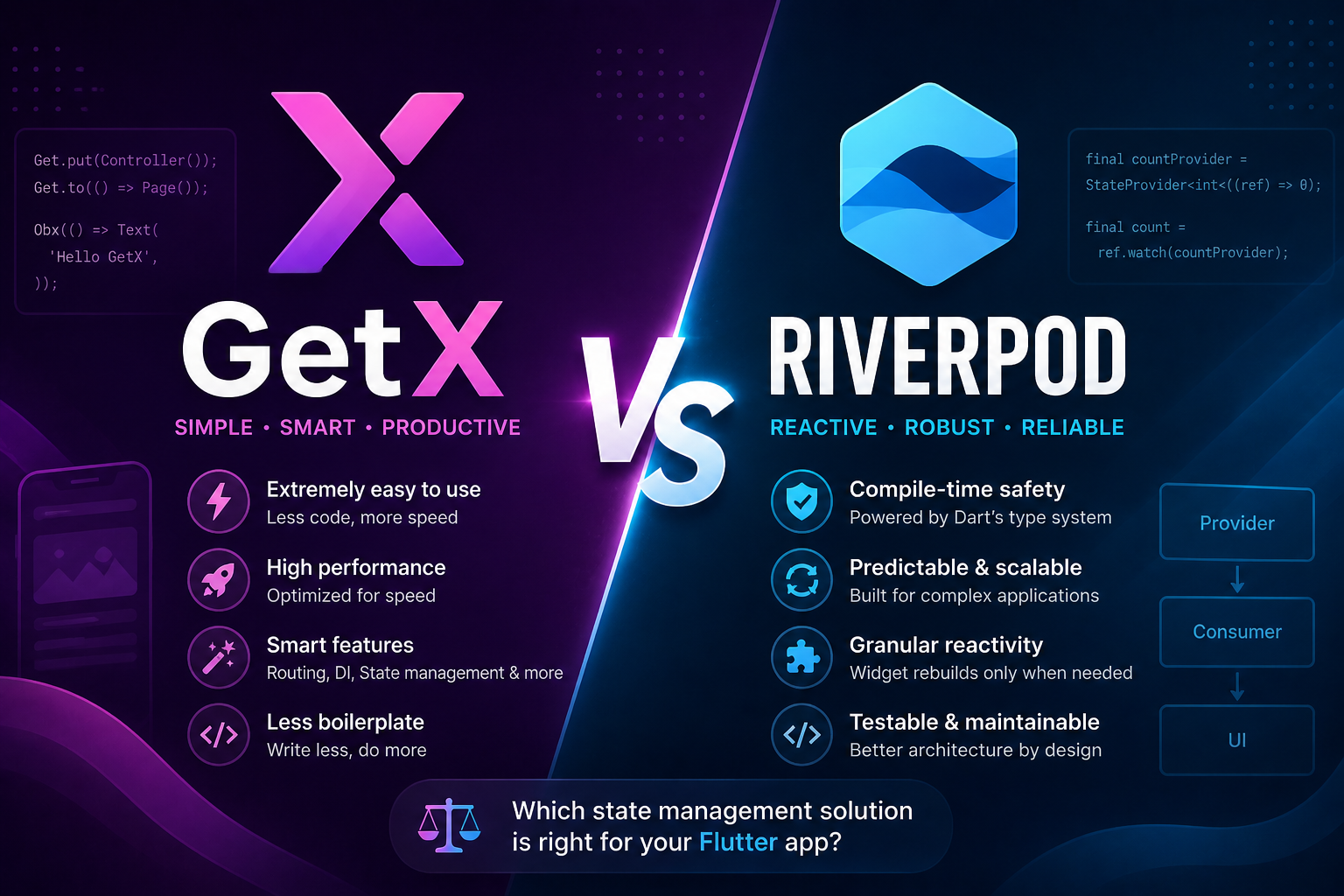
If Riverpod versus Bloc is an argument about philosophy, GetX versus Riverpod is more of an argument about scope. GetX isn't just a state management library — it also handles routing, dependency injection, and a handful of utility features, all with minimal syntax. Riverpod does one thing — state and dependency management — and does it with a stronger emphasis on safety and structure. Comparing them fairly means being honest about what each is actually trying to be.
What GetX actually offers
GetX's pitch is speed of development. A reactive variable is a .obs suffix. Navigation is a one-line Get.to() call with no BuildContext needed. Dependency injection is Get.put() and Get.find(). For a small app or a fast prototype, this is genuinely appealing — you can wire up a working, reactive screen in very little code, and the syntax reads almost like plain Dart with a little reactive sugar sprinkled on top.
It also bundles things Riverpod deliberately leaves to other packages: routing, snackbars/dialogs without context, simple internationalization helpers. If you want one package that handles "most of the app-level plumbing," GetX is built for exactly that.
What Riverpod actually offers
Riverpod is narrower by design. It handles reactive state and dependency injection, full stop — routing is left to go_router or Navigator directly, and it doesn't try to be a general-purpose utility belt. What it does provide, deliberately, is compile-time safety: accessing a provider that doesn't exist, or accessing the wrong type, is caught by the analyzer, not discovered at runtime in production. It's also built with testing as a first-class concern — providers can be overridden cleanly in tests without needing to mock a global singleton.
Where GetX genuinely wins
-
Raw development speed for small projects. If you're building an MVP, a personal project, or a small internal tool where long-term maintainability isn't the priority, GetX lets you move fast with very little ceremony. Fewer concepts to learn, fewer files to wire together.
-
One package instead of several. Not needing to separately choose a router, a DI solution, and a state management library is a real convenience for smaller teams or solo developers who'd rather not evaluate three separate ecosystem choices.
-
Approachable for developers newer to Flutter. The syntax is close enough to "just Dart with reactive variables" that it doesn't require understanding a new architectural pattern before being productive.
Where Riverpod genuinely wins
Compile-time safety versus runtime magic. GetX relies heavily on service-locator-style global access (Get.find<T>()), which means a missing or mistyped dependency is a runtime crash, not a compile error. On a growing codebase, this class of bug becomes more common, not less, as more developers touch more screens.
Testability. GetX's global-singleton-style architecture makes true isolated unit testing more awkward — tests can leak state between each other if you're not careful about resetting Get's global container. Riverpod's providers are naturally scoped and overridable per test, which is a meaningfully better foundation for a serious test suite.
Long-term maintainability at scale. GetX's flexibility is also its risk: because it allows accessing state and triggering navigation from almost anywhere with minimal structure, larger codebases can accumulate tangled, hard-to-trace dependencies between screens. Riverpod's more explicit provider graph makes it easier to reason about what depends on what, even months later.
Community and long-term maintenance trajectory. This is worth being direct about: Riverpod has strong, active, well-funded maintenance and is widely considered part of the more "official" Flutter ecosystem direction (its creator is also deeply involved in the Provider package and broader Flutter tooling conversations). GetX's maintenance history has had more visible gaps and community concern over time. For a project with a multi-year horizon, this is a real, practical factor, not just a preference.
What we'd actually recommend
For a fast prototype, an MVP you expect to rebuild anyway, or a small solo project, GetX's speed is a legitimate advantage and the maintainability concerns matter less because the app's lifespan is short by design.
For anything meant to be a real, long-lived production app — which, if you're reading a comparison article like this for a client or company project, is probably you — Riverpod's safety guarantees and testability are worth the slightly steeper initial learning curve. The cost of a runtime crash from a missing dependency, or an untestable tangle of global state, compounds over the life of a real product in a way that a quick prototype never has to face.
The practical answer
If you're choosing for a new production app today, Riverpod is the safer long-term bet for most teams — not because GetX is bad, but because the specific risks GetX carries (runtime-discovered errors, harder testing, a less certain long-term maintenance trajectory) are exactly the kind of risk that gets more expensive the longer a codebase lives and the more people work on it. GetX remains a reasonable choice specifically when speed matters more than longevity — just go in with clear eyes about which of those two things your project actually needs.