Top AI Programming Languages You Should Learn
Python still leads by a wide margin, but the languages around it — the ones handling performance, deployment, and scale — matter just as much for anyone building real AI systems.
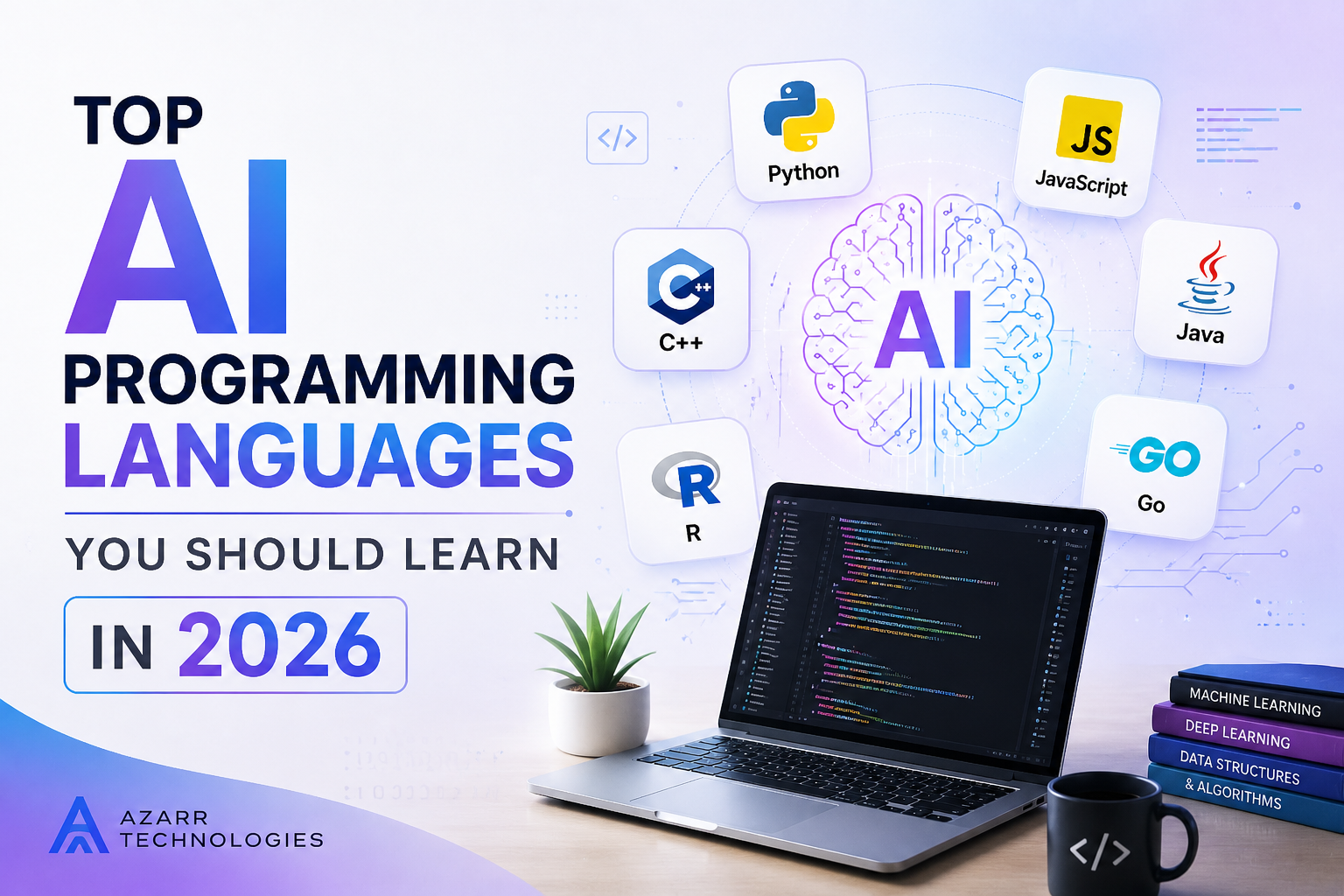
Ask ten developers which language to learn for AI and most will say Python without hesitation. That's the right instinct, but it's an incomplete answer. Real production AI systems are rarely built in one language — Python does the modeling and prototyping, while other languages quietly handle the performance-critical, large-scale, and deployment work around it. If you're deciding what to actually invest time learning in 2026, it's worth understanding the full picture, not just the headline.
Python — still the obvious starting point

The numbers aren't close. Recent developer surveys put Python's usage at roughly 70% of machine learning projects, and separate industry data puts global adoption at around 58% — different methodologies, same clear conclusion: nothing else is in the same tier.
The reason isn't mysterious. Python's ecosystem — TensorFlow, PyTorch, Scikit-learn, LangChain — covers essentially every stage of an AI project, from data cleaning through model training to deploying a chat interface on top of a language model. Combined with genuinely readable syntax, it remains the correct first language for almost anyone starting in AI, regardless of what else they eventually learn.
Best for: machine learning, deep learning, NLP, rapid prototyping, and — realistically — the majority of your actual day-to-day work if you're new to the field.
C++ — where speed actually matters
Once a model needs to run in real time — autonomous vehicles, robotics, high-frequency inference at scale — Python's overhead becomes a real constraint. This is C++'s territory: tools like TensorRT and ONNX Runtime exist specifically to take a model trained in Python and run it with the speed and low latency production systems demand.
Best for: real-time inference, embedded AI, performance-critical systems where milliseconds genuinely matter.
Java — the enterprise backbone
Less exciting to talk about, consistently relevant in practice. Large organizations with existing Java infrastructure — banking, insurance, logistics — build their AI systems on top of what they already have, and Java's platform independence and mature tooling make that integration straightforward rather than a rewrite-everything proposition.
Best for: large-scale enterprise AI systems, anywhere AI needs to plug into an existing Java backend.
R — the statistician's tool
R hasn't gone anywhere, and for good reason: its statistical computing and visualization capabilities remain genuinely stronger than Python's in specific research-heavy contexts. Finance, healthcare analytics, and academic research still lean on R specifically because the statistical rigor built into the language itself hasn't been fully matched elsewhere.
Best for: statistical modeling, predictive analytics, research environments where the analysis itself is the product.
Julia — the fastest-rising name on this list
Julia's pitch is genuinely compelling: syntax approachable enough to feel Python-like, with execution speed close to C++, aimed directly at eliminating the common "prototype in Python, rewrite in C++ for production" cycle. It's described across multiple 2026 industry roundups as the fastest-growing option specifically for scientific and numerical AI work — worth watching, especially if your work leans heavily computational rather than purely model-training.
Best for: scientific computing, numerical simulation, teams that want prototype and production performance in one language.
JavaScript — AI in the browser
As more AI features move client-side — in-browser inference, interactive AI-powered tools, lightweight models running without a server round-trip — JavaScript has become a genuine, not niche, part of the AI language conversation. If your interest in AI is building user-facing products rather than training models yourself, this is likely closer to your actual daily language than Python will ever be.
Best for: browser-based AI features, AI-powered web applications, teams building the product layer on top of models others have trained.
Rust and Go — the infrastructure layer
Neither trains models. Both increasingly run the systems around them — the high-throughput services, the deployment infrastructure, the parts of an AI product that need to be fast, memory-safe, and reliable at scale, without needing Python's flexibility. If your interest is AI infrastructure rather than AI research, these are worth knowing.
What we'd actually recommend
If you're choosing your first language for AI: Python, without hesitation. The ecosystem argument alone settles it, and everything else on this list is easier to pick up once you understand the underlying concepts through Python's more forgiving syntax.
If you're already comfortable with Python and deciding what to add next, the honest answer depends entirely on what kind of AI work you actually want to do — not on which language sounds most impressive. Building products people use day to day points toward JavaScript. Working on performance-critical or embedded systems points toward C++ or Rust. Research-heavy, statistics-first work points toward R or Julia. The mistake is treating this as a single ranked list to climb — it's a set of tools that solve genuinely different problems, and the right one depends on which problem you're actually trying to solve.
Best Languages for Learning AI